

A Portrait of Hornsey Town Hall
Hornsey Town Hall has had a rich and varied history from its ground-breaking design in 1935 to the concerts held there by Queen and the Kinks in the '70s. Now the town hall needs your help to enable it to flourish again. See how the building was once the heart of the community.
Until 1935 Hornsey lacked that essential focus for civic pride, a worthy town hall. As Hornsey transformed into a populous suburb in the 1880's there was a requirement for a much larger Town Hall and Hornsey Borough were able to purchase a large plot which fronted on Crouch End Broadway.
The site on the East of the broadway originally formed part of the garden of Old Crouch Hall. When the site was selected for the new Town Hall the loss of the public park was deeply regretted by residents.
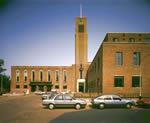 In 1929 a competition for best design was publicised.
The results of the competition were advertiied in 1933 and there had been no less than 218 competitors. The first prize went to Reginald Uren whose design was a noticeable departure from the conservative tradition of English municipal buildings.
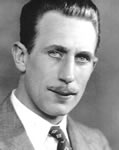 The Architect
Reginald Harold Uren was born in 1906 in Christchurch, New Zealand and came to England in 1930. In 1933 he won the Manchester Building Trades Exhibition Competition and then the Hornsey Town Hall. On its completion the building was awarded a bronze medal by the Royal Institute of British Architects.
Uren joined the firm of Slater and Moberly and was on the RIBA's standing committee on art. His firm designed John Lewis in Oxford Street and showrooms for Sandersons nearby in Berners Street (now the exclusive Sanderson hotel)
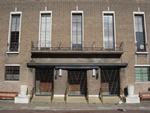 The Buildings
The public hall to the north is distinguished by the elongated windows of the foyer, above a generous triple entrance.
The council offices are approached by the smaller more decorative footway at the foot of the staircase tower.
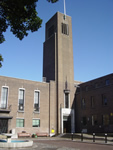 The appearance of the exterior with its plain surfaces of specially chosen small bricks, with its dominating tower and elongated windows with pronounced keystones, pays direct homage to one of the most influential of recent continental buildings, the Town Hall at Hilversum, of 1928-30 by W.M. Dudok.
At Hornsey the austerity of this brick tradition is leavened by the carved stone lintel by the sculptor A.J. Ayers and by ornamental metalwork.
The Interiors
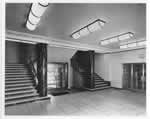
Much attention is also given to the interior finishes: the staircase is of Ashburton marble, the main rooms are panelled in a variety of fine woods.
All survive remarkably complete, even down to the original furniture and cork-tiled floors.
The Gas and Electricity showrooms
A few years later the setting for the town hall was further enhanced by the building of the Gas and Electricity Showrooms (now the bank and electrical shop). The combination appears to be unique: the Town Hall flanked by the headquarters of the utilities bring light, heat and comfort to the modern home. United by the use of brick and Ayers sculptural decoration, the whole group is calm and dignified statement of twentieth-cenury ideals, facing the flurry of a Victorian shopping centre.
 The Decline
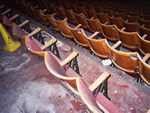
The Town Hall ceased to function as such when the Borough of Hornsey was absorbed in 1965 into the new Borough of Haringey and Wood Green's Civic Centre was chosen from the three available town halls for council meetings.
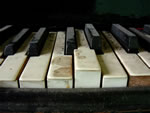 The public halls were closed because the cost of maintaining them in a safe condition were not met by the council. Since then they have since been used as storage space. The roof was not maintained and water leaks caused damaged to some of the interior. Part of the interior, such as the council chamber, has been sealed off because of an asbestos risk.
 The Future
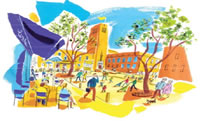
The Trust aims to bring this site and buildings back into general public use and create a dynamic heart to the centre of Crouch End providing a valuable endowment for the wider community of Haringey and London.
Extracts taken from Hornsey Historical Society's booklet "Our Civic Pride Hornsey Town Hall" by Dr Bridget Cherry. ©2004 Hornsey Historical Society. With thanks for to both parties for their permission
Photographs must not be reproduced without permission. Used with kind permission of the RIBA and Martin Charles Architectural Photography (mouse over the picture to see individual credits where applicable)
.gif)